
KVM vs LXC: Which Virtualization Technology Is Right for Your VPS?
Virtualization is the invisible engine behind modern hosting. Every cloud server, VPS, and scalable deployment relies on it—but most people don’t realize there are very different approaches powering what looks like the same product on the surface.
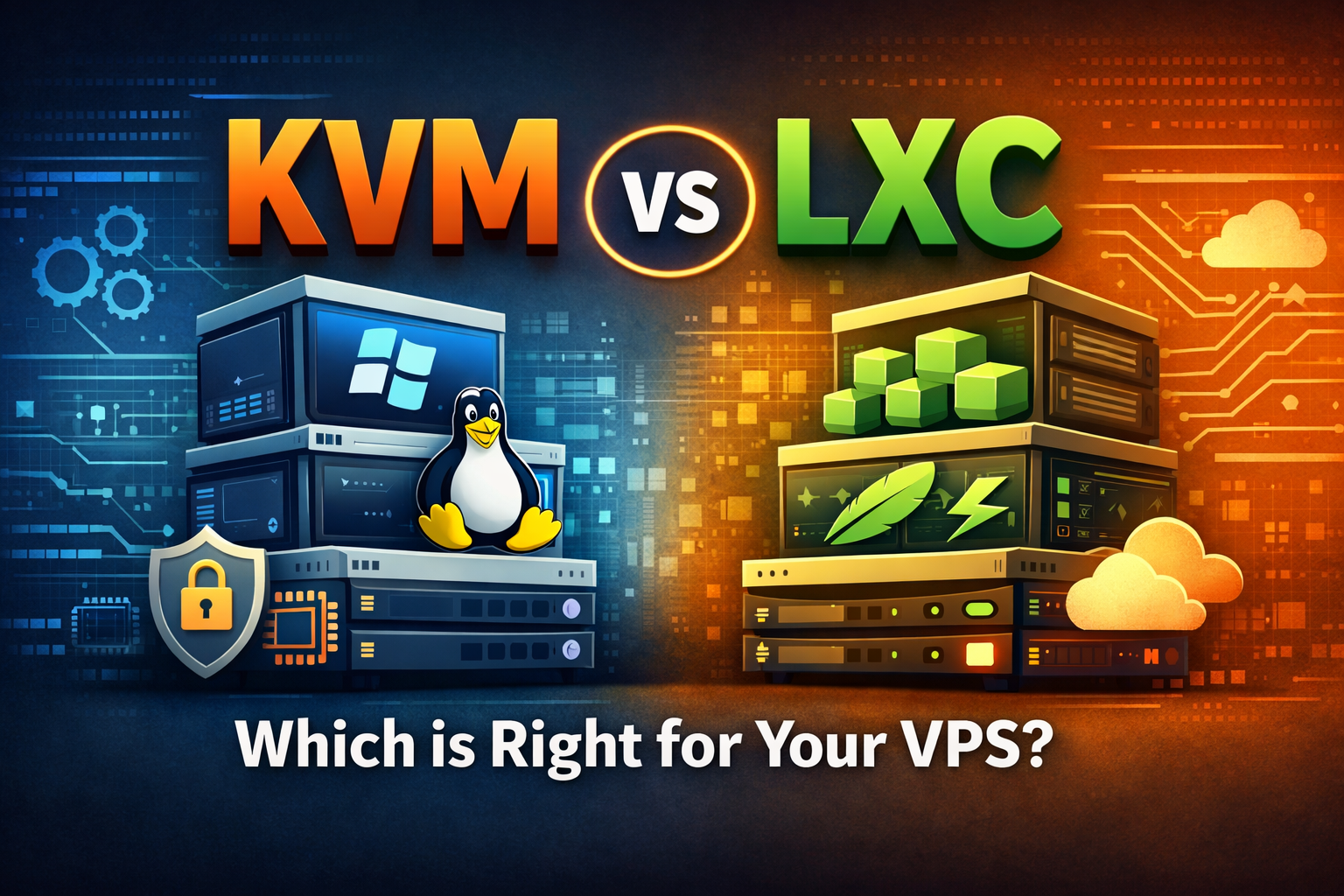
Virtualization is the invisible engine behind modern hosting. Every cloud server, VPS, and scalable deployment relies on it—but most people don’t realize there are very different approaches powering what looks like the same product on the surface.
Two of the most widely used technologies in the VPS world today are KVM and LXC. Both are mature, battle-tested, and capable of running serious workloads—but they solve the virtualization problem in fundamentally different ways.
Understanding those differences can help you choose the right VPS, avoid overpaying, and get better performance out of your infrastructure.
Let’s take a closer look.
Virtualization: From Bare Metal to the Cloud
Before virtualization, running multiple workloads meant running multiple physical servers. This was expensive, inefficient, and difficult to scale. Servers often sat underutilized, consuming power and rack space while doing very little.
Virtualization changed everything by allowing a single physical machine to be divided into many isolated environments. Each environment behaves like its own server, even though it’s sharing the same hardware.
Modern virtualization enables:
- Rapid provisioning (servers in seconds, not days)
- Resource isolation between users
- Better performance per dollar
- Flexible scaling without downtime
KVM and LXC both achieve these goals—but in very different ways.
What Is KVM Virtualization?
KVM (Kernel-based Virtual Machine) is a full virtualization technology built directly into the Linux kernel. When KVM is enabled, Linux becomes a type-1 hypervisor capable of running fully virtualized machines.
Each KVM VPS includes:
- Its own kernel
- Virtualized hardware (CPU, disk, NICs)
- Independent boot process
- Full operating system control
From the guest OS’s perspective, it’s running on real hardware.
Why KVM Is So Popular
KVM has become the industry standard for VPS hosting because it offers strong isolation and flexibility.
Key advantages include:
Full OS Freedom
You can run almost any operating system supported by the hypervisor, including multiple Linux distributions and Windows.
Strong Security Isolation
Each virtual machine is isolated at the hardware level. A compromised VM cannot access the host or other guests.
Kernel Customization
Users can install custom kernels, kernel modules, and low-level system software.
Predictable Resource Allocation
CPU and memory limits are strictly enforced, making performance more consistent across tenants.
The Trade-offs of KVM
That flexibility comes at a cost.
- Higher memory usage per VM
- Slightly reduced performance due to virtualization overhead
- Slower boot times compared to containers
For many workloads, these trade-offs are negligible—but for high-density hosting, they add up.
What Is LXC Virtualization?
LXC (Linux Containers) takes a different approach. Instead of virtualizing hardware, LXC virtualizes the operating system.
All LXC containers:
- Share the host’s Linux kernel
- Run isolated user spaces
- Use Linux namespaces and cgroups for isolation
To the user, an LXC container feels like a virtual machine. Under the hood, it’s much closer to a native Linux process.
Why LXC Is So Efficient
Because containers don’t need to emulate hardware or run separate kernels, they are extremely lightweight.
Key advantages include:
Near Bare-Metal Performance
Applications run almost as fast as they would directly on the host.
Instant Boot Times
Containers start in seconds—or less.
High Server Density
Many more LXC containers can run on the same hardware compared to KVM VMs.
Lower Cost per VPS
Less overhead means better pricing without sacrificing performance.
The Trade-offs of LXC
LXC does have limitations:
- Linux-only environments
- Shared kernel means kernel exploits are more impactful
- Limited kernel-level customization
For most web, application, and development workloads, these trade-offs are acceptable—and often worth it.
Performance: Real-World Differences
In benchmarks and real-world usage, LXC containers often outperform KVM VMs when running the same workload on the same hardware.
Why?
- No hardware emulation layer
- Fewer context switches
- Lower memory pressure
This makes LXC especially attractive for:
- Web hosting
- API services
- CI/CD pipelines
- Game servers
- Development environments
KVM, on the other hand, shines in scenarios where isolation matters more than raw performance.
Security Considerations
Security is often the deciding factor between KVM and LXC.
KVM Security Model
- Hardware-level isolation
- Separate kernels
- Strong containment boundaries
LXC Security Model
- Shared kernel
- Namespace isolation
- Relies heavily on host hardening
A properly configured LXC environment is still very secure, especially when managed through platforms like Proxmox—but KVM remains the safer choice for untrusted workloads.
Management with Proxmox
Platforms like Proxmox VE bring both technologies together under a single interface, making it easy to deploy, manage, and scale KVM and LXC workloads side by side.
Proxmox adds:
- Web-based management
- Backup and snapshot support
- Resource scheduling
- High availability clustering
This hybrid approach lets providers—and users—choose the best virtualization type for each task instead of committing to just one.
Which One Should You Choose?
There’s no universal answer, but there is a smart way to decide.
Choose KVM if you need:
- Windows VPS
- Custom kernels
- Maximum isolation
- Compliance-driven environments
Choose LXC if you want:
- Best performance per dollar
- Linux-only workloads
- Fast provisioning
- High efficiency
Many experienced users end up using both.
The Future of Virtualization
Virtualization continues to evolve. Containers, microVMs, and hybrid models are reshaping how infrastructure is deployed. Yet KVM and LXC remain foundational technologies that aren’t going anywhere.
Their maturity, stability, and flexibility make them ideal building blocks for modern cloud platforms.
Final Thoughts
Virtualization isn’t just a technical detail—it directly impacts performance, cost, and reliability. Understanding the difference between KVM and LXC helps you make better infrastructure decisions and get more value from your VPS.
Rather than asking which technology is “better,” ask which one best fits your workload.
That’s where real optimization begins.